

Founded in 1968 and internationally distinguished in Iberian, Latin American, Irish, and 18th-century studies, Bucknell University Press has been publishing books in the arts, humanities, and social sciences for more than 50 years and is a member of Association of University Presses. Since mid-2018, we have partnered with Rutgers University Press for book production and distribution services; this partnership makes possible the open availability of books published during this period to the campus community through the Bucknell Digital Commons. Print copies of these books may be ordered online. For more detail about Bucknell University Press, please visit our website, which includes complete backlist details, searchable catalogs, and contact information.
Bucknell University restricts access of these files to members of the Bucknell community who hold credentials that allow access to online material in accordance with Bucknell's network use policy. The files may not be posted elsewhere online and community members may not share the file with other users. Violation of this policy may result in suspension of access to the files.











-
The Poetics of Epiphany in the Spanish Lyric of Today
Judith Nantell, Luis Muñoz, Abraham Gragera, Josep M. Rodríguez, and Ada Salas
Drawing on the poetry of four major voices in the Spanish lyric of today, Judith Nantell explores the epistemic works of Luis Muñoz, Abraham Gragera, Josep M. Rodríguez, and Ada Salas, arguing that, for them, the poem is the fundamental means of exploring the nature of both knowledge and poetry. In this first interpretive analysis of the epistemic nature of their poetry, Nantell innovatively engages these poets, each of whom has contributed one of their own poems along with a previously unpublished explication of their chosen poem. Each also provides an original biographical sketch to support Nantell’s development of a poetics of epiphany.
Published by Bucknell University Press. Distributed worldwide by Rutgers University Press.
-
Cultivating Peace : The Virgilian Georgic in English, 1650-1750
Melissa Schoenberger
During the decades following the English civil wars, British poets seeking to make sense of lingering political instabilities turned to Virgil’s Georgics. This ancient poem betrays deep ambivalences about war, political power, and empire, and such poets as Andrew Marvell, John Dryden, and Anne Finch found in these attitudes valuable ways of responding to the uncertainties of their own time. Composed during a period of brutal conflict in Rome, Virgil’s agricultural poem distrusts easy stability, urging its readers to understand that lasting peace must be sowed, tended, reaped, and replanted, year after year. Like the ancient poet, who famously depicted a farmer’s scythe suddenly recast as a sword, the poets discussed in Cultivating Peace imagine states of peace and war to be fundamentally and materially linked. In distinct ways, they dismantle the dream of the golden age renewed, proposing instead that peace must be sustained by constant labor.
Published by Bucknell University Press. Distributed worldwide by Rutgers University Press.
-
Modern Spanish Women as Agents of Change : Essays in Honor of Maryellen Bieder
Jennifer Smith, Jennifer Smith, Akiko Tsuchiya, Christine Arkinstall, Roberta Johnson, Susan M. McKenna, Linda Willem, and Denise DuPont
This volume brings together cutting-edge research on modern Spanish women as writers, activists, and embodiments of cultural change, and simultaneously honors Maryellen Bieder’s invaluable scholarly contribution to the field. The essays are innovative in their consideration of lesser-known women writers, focus on women as political activists, and use of post-colonialism, queer theory, and spatial theory to examine the period from the Enlightenment until World War II. The contributors study women as agents and representations of social change in a variety of genres, including short stories, novels, plays, personal letters, and journalistic pieces. Canonical authors such as Emilia Pardo Bazán, Leopoldo Alas “Clarín,” and Carmen de Burgos are considered alongside lesser known writers and activists such as María Rosa Gálvez, Sofía Tartilán, and Caterina Albert i Paradís. The critical analyses are situated within their specific socio-historical context, and shed new light on nineteenth- and early twentieth-century Spanish literature, history, and culture.
Published by Bucknell University Press. Distributed worldwide by Rutgers University Press.
-

The Memory Sessions
Suzanne Farrell Smith
Suzanne Farrell Smith’s father was killed by a drunk driver when she was six, and a devastating fire nearly destroyed her house when she was eight. She remembers those two—and only those two—events from her first nearly twelve years of life. While her three older sisters hold on to rich and rewarding memories of their father, Smith recalls nothing of him. Her entire childhood was, seemingly, erased. In The Memory Sessions, Smith attempts to excavate lost childhood memories. She puts herself through multiple therapies and exercises, including psychotherapy, hypnotherapy, somatic experiencing, and acupuncture. She digs for clues in her mother’s long-stored boxes. She creates—with objects, photographs, and captions—a physical timeline to compensate for the one that’s missing in her memory. She travels to San Diego, where her family vacationed with her father right before he died. She researches, interviews, and meditates, all while facing down the two traumatic memories that defined her early life. The result is an experimental memoir that upends our understanding of the genre. Rather than recount a childhood, The Memory Sessions attempts to create one from research, archives, imagination, and the memories of others.
Published by Bucknell University Press. Distributed worldwide by Rutgers University Press.
-

Faust : A Tragedy, Part I
Eugene Stelzig and Johann Wolfgang von Goethe
Goethe is the most famous German author, and the poetic drama Faust, Part I (1808) is his best-known work, one that stands in the company of other leading canonical works of European literature such as Dante’s Inferno and Shakespeare’s Hamlet. This is the first new translation into English since David Constantine’s 2005 version. Why another translation when there are several currently in print? To invoke Goethe’s own authority when speaking of his favorite author, Shakespeare, Goethe asserts that so much has already been said about the poet-dramatist “that it would seem there’s nothing left to say,” but adds, “yet it is the peculiar attribute of the spirit that it constantly motivates the spirit.” Goethe’s great dramatic poem continues to speak to us in new ways as we and our world continually change, and thus a new or updated translation is always necessary to bring to light Faust’s almost inexhaustible, mysterious, and enchanting poetic and cultural power. Eugene Stelzig’s new translation renders the text of the play in clear and crisp English for a contemporary undergraduate audience while at the same time maintaining its leading poetic features, including the use of rhyme.
Published by Bucknell University Press. Distributed worldwide by Rutgers University Press.
-
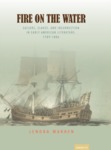
Fire on the Water : Sailors, Slaves, and Insurrection in Early American Literature, 1789-1886
Lenora Warren
Lenora Warren tells a new story about the troubled history of abolition and slave violence by examining representations of shipboard mutiny and insurrection in late eighteenth- and early nineteenth-century Anglo-American and American literature. Fire on the Water centers on five black sailors, whose experiences of slavery and insurrection either inspired or found resonance within fiction: Olaudah Equiano, Denmark Vesey, Joseph Cinqué, Madison Washington, and Washington Goode. These stories of sailors, both real and fictional, reveal how the history of mutiny and insurrection is both shaped by, and resistant to, the prevailing abolitionist rhetoric surrounding the efficacy of armed rebellion as a response to slavery. Pairing well-known texts with lesser-known figures (Billy Budd and Washington Goode) and well-known figures with lesser-known texts (Denmark Vesey and the work of John Howison), this book reveals the richness of literary engagement with the politics of slave violence.
Published by Bucknell University Press. Distributed worldwide by Rutgers University Press.
-
Woven Shades of Green : An Anthology of Irish Nature Literature
Tim Wenzell
Woven Shades of Green is an annotated selection of literature from authors who focus on the natural world and the beauty of Ireland. The anthology begins with the Irish monks and their largely anonymous nature poetry, written at a time when Ireland was heavily forested. A section follows devoted to the changing Irish landscape, through both deforestation and famine, including the nature poetry of William Allingham, James Clarence Mangan, essays from Thomas Gainford and William Thackerary, and novel excerpts from William Carleton and Emily Lawless. The anthology then turns to the nature literature of the Irish Literary Revival, including Yeats and Synge, but also the poetry of many others, and an excerpt from George Moore’s novel The Lake. Part four of the anthology shifts to modern Irish nature poetry, beginning with Patrick Kavanaugh, and continuing with late twentieth-century, early twenty-first-century poetry of Seamus Heaney, Eavan Boland, and others. Finally, the anthology concludes with a section on various Irish naturalist writers, and the unique prose and philosophical nature writing of John Moriarty, followed by a comprehensive list of environmental organizations in Ireland, which seek to preserve the natural beauty of this unique country.
Published by Bucknell University Press. Distributed worldwide by Rutgers University Press.
-
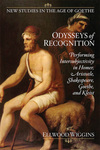
Odysseys of Recognition : Performing Intersubjectivity in Homer, Aristotle, Shakespeare, Goethe, and Kleist
Ellwood Wiggins
Literary recognition is a technical term for a climactic plot device. Odysseys of Recognition claims that interpersonal recognition is constituted by performance, and brings performance theory into dialogue with poetics, politics, and philosophy. By observing Odysseus figures from Homer to Kleist, Ellwood Wiggins offers an alternative to conventional intellectual histories that situate the invention of the interior self in modernity. Through strategic readings of Aristotle, this elegantly written, innovative study recovers an understanding of interpersonal recognition that has become strange and counterintuitive. Penelope in Homer’s Odyssey offers a model for agency in ethical knowledge that has a lot to teach us today. Early modern and eighteenth-century characters, meanwhile, discover themselves not deep within an impenetrable self, but in the interpersonal space between people in the world. Recognition, Wiggins contends, is the moment in which epistemology and ethics coincide: in which what we know becomes manifest in what we do.
Published by Bucknell University Press. Distributed worldwide by Rutgers University Press.
-
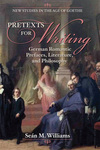
Pretexts for Writing : German Romantic Prefaces, Literature, and Philosophy
Seán M. Williams
Around 1800, print culture became a particularly rich source for metaphors about thinking as well as writing, nowhere more so than in the German tradition of Dichter und Denker. Goethe, Jean Paul, and Hegel (among many others) used the preface in order to reflect on the problems of writing itself, and its interpretation. If Sterne teaches us that a material book enables mind games as much as it gives expression to them, the Germans made these games more theoretical still. Weaving in authors from Antiquity to Agamben, Williams shows how European–and, above all, German–Romanticism was a watershed in the history of the preface. The playful, paradoxical strategies that Romantic writers invented are later played out in continental philosophy, and in post-Structuralist literature. The preface is a prompt for playful thinking with texts, as much as it is conventionally the prosaic product of such an exercise.
Published by Bucknell University Press. Distributed worldwide by Rutgers University Press.
-
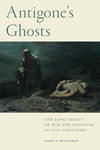
Antigone's Ghosts : The Long Legacy of War and Genocide in Five Countries
Mark A. Wolfgram
Sophocles' play Antigone is a starting point for understanding the perpetual problems of human societies, families, and individuals, who are caught up in the terrible aftermath of mass violence. What is one to do after the killing has stopped? What can be done to prevent a round of new violence? The tragic and dramatic tension in the play is put in motion by setting an unyielding Antigone against King Creon. As we see through the investigation of how Germany, Japan, Spain, Yugoslavia and Turkey have dealt with their histories of mass violence and genocide in the 20th century, the forces represented by Antigone and Creon remain very much part of our world today. Through a comparison of the five countries, their political institutions, and cultural traditions, we begin to appreciate the different pathways that societies have taken when confronting their violent histories.
Published by Bucknell University Press. Distributed worldwide by Rutgers University Press.
-
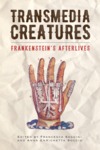
Transmedia Creatures : Frankenstein’s Afterlives
Francesca Saggini, Anna Enrichetta Soccio, Lidia DeMichelis, Eleanor Beal, Gino Roncaglia, Claire Nally, Claudia Gualtieri, and Federico Meschini
On the 200th anniversary of the first edition of Mary Shelley’s Frankenstein, Transmedia Creatures presents studies of Frankenstein by international scholars from converging disciplines such as humanities, musicology, film studies, television studies, English and digital humanities. These innovative contributions investigate the afterlives of a novel taught in a disparate array of courses - Frankenstein disturbs and transcends boundaries, be they political, ethical, theological, aesthetic, and not least of media, ensuring its vibrant presence in contemporary popular culture. Transmedia Creatures highlights how cultural content is redistributed through multiple media, forms and modes of production (including user-generated ones from “below”) that often appear synchronously and dismantle and renew established readings of the text, while at the same time incorporating and revitalizing aspects that have always been central to it. The authors engage with concepts, value systems and aesthetic-moral categories—among them the family, horror, monstrosity, diversity, education, risk, technology, the body—from a variety of contemporary approaches and highly original perspectives, which yields new connections. Ultimately, Frankenstein, as evidenced by this collection, is paradoxically enriched by the heteroglossia of preconceptions, misreadings, and overreadings that attend it, and that reveal the complex interweaving of perceptions and responses it generates.
Published by Bucknell University Press. Distributed worldwide by Rutgers University Press.